
GBCORP BLOG · SUSTAINABILITY
Solar Fence vs Ground-Mount Array: When Your Perimeter Beats a Field
A ground-mount array asks a simple, expensive question: how much land can you give it? A bifacial solar fence asks a cheaper one: how long is your perimeter? For many sites, the boundary they already own beats the field they would have to spare.
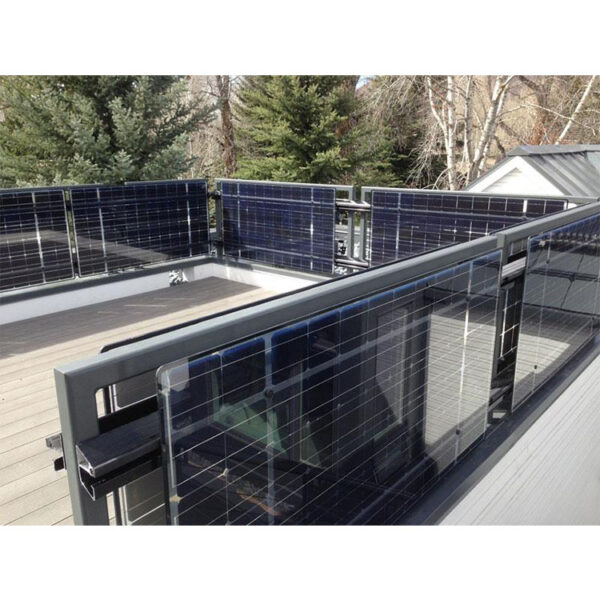
Ground-mount solar is efficient per panel and hungry for land — every kilowatt wants its own patch of tilted ground. On sites where land is the scarce input, that hunger is the whole problem. A solar fence sidesteps it by generating on a surface the site was going to build anyway: its boundary.
Land is the real constraint
Farms, logistics yards, industrial plants and estates all need a perimeter, and they all guard their usable land. A ground-mount field takes that land out of production. GBCORP's double bifacial monocrystalline solar fence stands vertically along the boundary line — zero extra footprint — turning a cost item (fencing) into a generating asset.
Bifacial vertical: a different yield shape
A vertical bifacial fence captures light on both faces, lifting yield 10–30 % over a mono-facial panel depending on ground reflectance and site. Standing upright, it peaks in the morning on one face and the evening on the other, producing a broader, flatter daily curve than a noon-peaking tilted array — useful where load runs across the day rather than clustering at midday.
Dual purpose is the hidden economics
The array does one job; the fence does two. It secures the site and generates, so part of its cost is offset against the perimeter you had to build regardless. Tempered glass on both sides and a corrosion-resistant aluminium frame handle high wind, dust and sand — the conditions boundary hardware faces anyway.
| Factor | Ground-mount array | Bifacial solar fence |
|---|---|---|
| Extra land required | Significant | None — uses the boundary |
| Serves a second purpose | No | Yes — perimeter security |
| Daily generation shape | Midday peak | Morning + evening, flatter |
| Yield vs mono-facial | Baseline | +10–30% (bifacial) |
| Best where | Land is cheap and spare | Land is scarce or productive |
When each wins
If land is plentiful and cheap, a ground-mount field still maximises raw output. If land is scarce, productive or expensive — most farms, yards, plants and estates — the fence you already needed is the better kilowatt. The 2026 solar fence guide (bifacial yield & costs) works through the yield maths.
See the GBCORP Double Bifacial Monocrystalline Solar Panel Fence or browse the GBCORP Sustainability e-shop. GBCORP delivers building-integrated photovoltaics across 17 countries on 4 continents.










