
GBCORP BLOG · SUSTAINABILITY
Transparent Solar Glass in 2026: Costs, VLT and 6 Buyer Questions
Transparent photovoltaic glass has crossed from architectural novelty to a priced, certified, deliverable building product. This guide covers what it genuinely costs in 2026, how to specify VLT, and the questions that reveal whether a supplier can actually deliver.
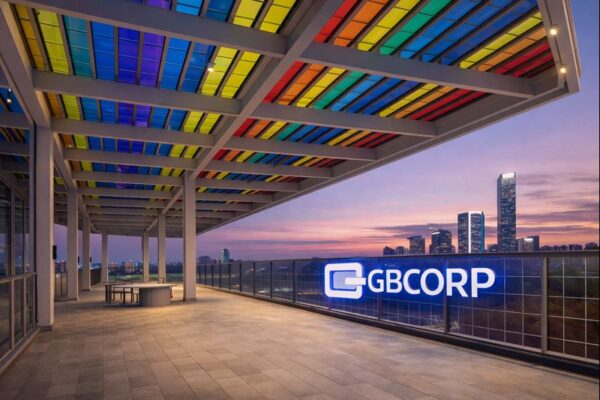
Five years ago, transparent solar glass lived in press releases. In 2026 it ships against glass schedules, carries CE marking and IEC certification, and appears in tenders from Munich to the Gulf. What follows is the buyer's view: real numbers, real trade-offs, and the shortlist questions we hear from architects, contractors and building owners every week.
What it really costs in 2026
Published market data puts building-integrated photovoltaic glazing in these bands:
| Product class | Typical 2026 price band | Notes |
|---|---|---|
| Standard BIPV glass-glass module | ≈ €95 – €250 / m² | Module only, standard sizes |
| Semi-transparent thin-film glazing (CdTe / a-Si) | ≈ €200 – €400 / m² | Custom sizes and VLT raise the band |
| Installed cost, new construction | ≈ $280 – $380 / m² | Glazing system and electrical included |
The single most common mistake is comparing those figures to rooftop panels. The honest comparison is to the glass you were buying anyway: premium solar-control glazing is far from free, and every euro it costs is a euro the photovoltaic version offsets before generating its first watt. Analysts call this the material-substitution effect, and it is why BIPV pays back faster on new builds and re-cladding projects than a naïve calculation suggests.
VLT: the one number that shapes everything
Visible light transmission determines how the glass looks, how the interior feels, and how much power you harvest — the three pull against each other:
| VLT range | Looks like | Best for | Relative output |
|---|---|---|---|
| 40 – 70 % | Lightly tinted vision glass | Offices, retail frontage, homes | Lower |
| 20 – 40 % | Classic solar-control tint | Skylights, atria, hot-climate façades | Medium |
| < 20 % | Deep architectural shading | Spandrels, balustrades, sun-baked elevations | Higher |
A practical specification trick: vary VLT by orientation. Clear-leaning glass on the north face, deeper harvest on the south and west — the building looks uniform from the street, but each elevation is tuned.
CdTe, amorphous silicon, or crystalline inlay?
CdTe thin film — today's mainstream for transparent glazing: uniform tint with no visible cell pattern, strong performance in heat and diffuse light, and the best cost-per-watt among see-through options. This is the chemistry behind the GBCORP Transparent CdTe Thin-Film Solar Glass Panel.
Amorphous silicon (a-Si) — the veteran thin film: slightly warmer tint, excellent temperature behaviour, well suited to custom shapes and heritage-sensitive roofs where uniform appearance matters.
Crystalline inlay — opaque cells spaced inside clear laminate: the highest output per panel, but with a visible cell grid and dappled shadows. Superb for canopies and pergolas; rarely right for vision glass.
The six questions that separate serious suppliers
1. "Certified to what?" — You want IEC 61215 and IEC 61730 as a photovoltaic product plus laminated safety glass standards (EN ISO 12543 / EN 14449) as a building product. Both, not either.
2. "Custom sizes, or catalogue sizes?" — Real façades are not built from standard rectangles. A supplier who cannot manufacture to your glass schedule is selling panels, not building envelopes.
3. "What exactly is the VLT and SHGC of my configuration?" — Per configuration, in writing, not a brochure range.
4. "Where do cables and junctions live?" — The correct answer names your glazing system: concealed edge junctions routed inside mullions or under cappings. If wiring is an afterthought, so is the product.
5. "What is the thermal behaviour?" — Thin film loses far less output in heat than crystalline (roughly −0.2 %/°C versus −0.35 to −0.45). On a 70 °C summer façade, that difference is real yield.
6. "Who engineers the electrical layout?" — String design across mixed panel sizes and orientations is engineering, not accessory selection. It belongs with the glass supplier.
The bottom line
If your project already includes premium glazing, transparent photovoltaic glass in 2026 costs a step more, works the day it is commissioned, and pays part of its way through cooling savings before you count a single kilowatt-hour. Start from the glass schedule, choose VLT by orientation, and insist on dual certification.
Request specifications for the GBCORP Transparent CdTe Thin-Film Solar Glass Panel, browse the full GBCORP Sustainability e-shop, or read how thin film escapes the window frame entirely in our piece on flexible rollable solar panels. GBCORP supplies building-integrated photovoltaics across 17 countries on 4 continents.










