
GBCORP BLOG · SUSTAINABILITY
5kW Wind Turbines: A 2026 Buyer's Guide to Vertical-Axis Hybrids
A 5kW wind turbine can carry a full household — or disappoint forever — depending on choices made before it is ever unboxed. This guide covers the numbers that matter, the vertical-axis difference, and why the smart money now buys wind and solar as one system.
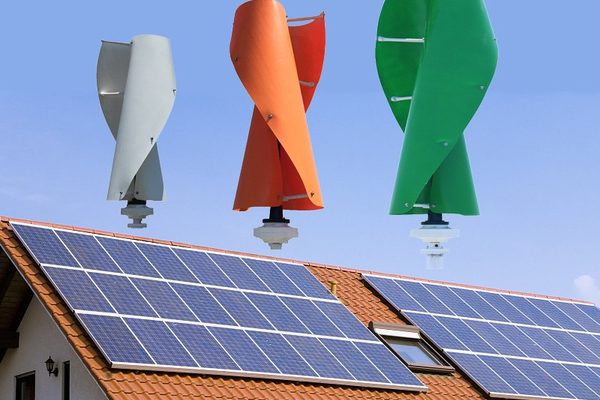
Small wind has a reputation problem, and it earned it honestly: a decade of horizontal turbines sold on peak output, mounted too low, in the wrong wind, by suppliers who had moved on before the first bearing failed. The technology that fixes most of this is not exotic — it is a different rotor geometry, a different generator, and a more honest way of reading the datasheet. Here is what a well-informed buyer looks for in 2026.
Vertical axis vs horizontal: why geometry decides
A horizontal-axis turbine must face the wind, so it spends gusty days hunting — yawing back and forth, losing energy with every correction. A vertical-axis wind turbine (VAWT) has no facing to do: wind from any direction drives it equally. That single property makes VAWTs the right choice for the turbulent, shifting winds around buildings, trees and coastlines — exactly where real customers actually live.
Vertical blades also carry their stress at the hub rather than the tip, which eliminates the classic blade-shedding failure mode, and their aerofoil profile can be shaped for quietness. A modern VAWT is difficult to hear above ambient wind — a decisive point anywhere neighbours exist.
The maglev difference
The second quiet revolution is the generator. In a magnetic-levitation (maglev) permanent-magnet generator, the rotor floats on magnetic suspension instead of resting on conventional bearings. Less friction means two things buyers care about: start-up at wind speeds as low as 1.5 m/s — a breeze most horizontal machines sleep through — and less mechanical wear over the years. In the 5–8 m/s band where most residential sites live, a maglev VAWT can harvest 10–30% more energy than a conventional equivalent.
Reading the datasheet like a professional
| Number | What it really tells you | Good looks like |
|---|---|---|
| Start-up wind speed | When the rotor begins turning at all | ≤ 2 m/s |
| Cut-in wind speed | When useful power actually flows | ≤ 3 m/s |
| Rated wind speed | Where the nameplate 5kW is achieved | 11–12 m/s (honest) |
| Survival wind speed | The storm it lives through | ≥ 40 m/s |
| Protection | How it stops in an emergency | Electromagnetic brake + dump load |
The trap sits between the lines: a turbine “rated” at a wind speed your site rarely sees will spend its life well below nameplate. That is not a flaw of the machine — it is physics — and it is exactly why the strongest systems no longer rely on wind alone.
Why hybrid is the honest answer
Wind and sun are complementary by nature: solar peaks at midday and disappears at night; wind often builds in the evening and blows through the dark. A wind–solar hybrid pairs a 5kW turbine with a 5kW array through one hybrid controller into shared lithium storage — 10kW of combined capacity with two independent sources feeding it. The practical result is fewer dead calms, smaller battery banks than a solar-only off-grid design, and generation that follows the day instead of fighting it.
A reference household — lights, refrigeration, computers, washing machine, microwave, a 2HP air conditioner — totals around 5.5kW of connected load. A 10kW hybrid with storage carries that comfortably, because the loads never all run at once.
Grid rules: the question to ask before you buy
Off-grid, a hybrid system is yours to enjoy from day one. Feeding the grid is a different matter: Australia and New Zealand require inverters certified to AS/NZS 4777.2 (and CEC-listed in Australia); other markets have their own lists. A serious supplier tells you this before you ask, and quotes the locally certified grid-tie inverter through your licensed installer rather than pretending the rules away.
Five questions that separate serious suppliers
1. “What is the survival wind speed — and how does it brake?” The answer should name a figure of 40 m/s or better and a dual mechanism.
2. “What exactly is in the kit?” Turbine, tower, wind controller, panels, hybrid inverter, storage, brackets, cabling — itemised. Missing items surface at installation, at your cost.
3. “Certified to what?” CE as a product, ISO 9001/14001 as a factory, test reports on request.
4. “What voltage and mast options fit my site?” Real systems configure: 12/24/48/96V DC bus, masts from 6 to 12 metres, battery sized to your evening load.
5. “Who answers in year three?” A brand with a contract address beats a listing that may not exist next season.

The bottom line
Buy the geometry that suits real wind (vertical), the generator that starts in a breeze (maglev), the architecture that never sleeps (hybrid with storage), and the supplier who volunteers the grid rules. The GBCORP 5kW Vertical-Axis Wind Turbine + Solar Hybrid System was assembled around exactly those answers — 1.5 m/s start-up, 40 m/s survival, 10kW combined capacity with lithium storage, CE/ISO manufacture, and configuration engineering included. Browse the full GBCORP e-shop for the rest of the sustainability line.
GBCORP delivers renewable-energy systems across 17 countries on 4 continents — engineered conservatively, quoted fixed, supported after commissioning.










